
Guides · Massage & Pain
Massage for Tension Headaches
By the West Valley Massage team · 2,526 words · Sources: NCCIH, NINDS · Updated
Both sides · pressing, not throbbing · no nausea · 7 warning signs in section 05 · open daily 9 AM to 8 PM
Private rooms Open every day, 9 AM – 8 PM Walk-ins welcome
Forest Grove, OR 97116
In this guide
Definitions
What a tension-type headache is
A tension-type headache is the ordinary headache — the most common kind there is, and the one almost everyone has had. NINDS describes headache disorders in categories, and this one sits in the primary group, meaning the headache is the condition, not a symptom of something else. The typical description is a dull, steady pressure on both sides of the head, often across the forehead or around the back and sides, mild to moderate, not disabling, and lasting anywhere from about half an hour to several days.
What it usually is not is dramatic. There is no throbbing that keeps time with a pulse, no nausea, and no urge to lie down in a dark room. People with tension-type headaches generally keep working through them, which is precisely why they get undertreated and why they turn into a background condition that someone tolerates for years. The pain is annoying rather than frightening, which is why it rarely gets an appointment.
The name is older than the understanding. "Tension" originally implied muscle tension in the neck and scalp as the direct cause, and the current picture is more complicated than that — pain sensitivity, stress, sleep, and the muscles around the head and neck all appear to be involved to varying degrees in different people. Mayo Clinic's discussion of tension headaches is a readable overview of where that thinking has landed.
- Both sides of the head, not one. A band, a cap, or pressure across the forehead.
- Pressing or tightening, not pulsing.
- Mild to moderate. Irritating enough to notice, usually not enough to stop the day.
- No nausea, and normal activity does not obviously make it worse.
- Frequently sore neck and shoulder muscles alongside it, and often tenderness at the base of the skull.
Before you book
Tension headache or migraine, and why it matters
This distinction is worth making before you spend money on either a session or a supplement, because the two conditions respond to entirely different things. A migraine is a neurological condition with its own treatments, its own triggers and, for some people, its own warning phase. A tension-type headache is a different animal. Treating one as though it were the other is the most common reason someone concludes that "nothing works" for their headaches.
The classic split is described consistently across the sources: tension-type on both sides, pressing, mild to moderate, not worsened by walking upstairs, no nausea; migraine more often on one side, throbbing, moderate to severe, made worse by routine activity, frequently with nausea and sensitivity to both light and sound. Plenty of real people sit somewhere in the middle, and some have both. That is a conversation for a doctor, not a therapist.
Why it matters for massage in particular: the case for hands-on work is much easier to make for the muscular, postural, stress-driven end of the spectrum than for a migraine. NCCIH's digest of what the science says about massage therapy is measured about headache outcomes generally, and nothing in it supports presenting massage as a migraine treatment. If you have been diagnosed with migraine, book a massage because an hour of quiet and less neck tension is worth having, not because you expect it to abort an attack.
| Tension-type | Migraine | |
|---|---|---|
| Where | Both sides, often a band around the head | Frequently one side |
| Quality | Steady pressing or tightening | Throbbing or pulsing |
| Intensity | Mild to moderate | Moderate to severe |
| Movement | Usually not made worse by climbing stairs | Routine activity typically makes it worse |
| Nausea | Not typical | Common |
| Light and sound | Sometimes one of them bothers you | Both commonly do |
| Warning phase | None | Some people get an aura beforehand |
| Usual response | Keep going, take something, carry on | Stop, go dark, lie down |
What the work does
What neck and scalp work does for a tension headache
The muscles that attach to the base of the skull, run down the back of the neck, and spread across the top of the shoulders are frequently tender in people who get tension-type headaches, and pressure on those areas produces sensations referred up into the head. Loosening them is low-risk, it is quick to try, and the immediate experience is often noticeably better. Many people leave a session with the pressure in their head reduced for the rest of the day.
That is what a 30-minute Local Massage is for. Concentrated work on the neck, shoulders, jaw and scalp is the most direct thing on the menu for a head that feels tight, and it is short enough to book on a bad afternoon rather than planning around. People who get headaches regularly tend to book it that way — when one is building, rather than on a schedule.
One boundary, because it decides whether this is the right hour. A massage therapist in Oregon is licensed for soft-tissue work rather than to diagnose why your head hurts, so a massage eases the muscular part of the problem and does not treat an underlying condition. If your headaches are frequent, severe, or new, see a physician who can look at the pattern properly — and use the massage alongside, which is how most people here handle it.
The cause you can change
Screens, posture, and where the day goes
The single most common story behind a run of tension-type headaches is unremarkable: a head held in one position, slightly forward of where it should be, for eight hours, five days a week. Whatever the deeper mechanism, the muscles at the back of the neck are working the whole time to hold a heavy object out over its base of support, and by four in the afternoon they are tired and sore. The headache arrives in the late afternoon, and by then it feels like it came from nowhere.
This is the part of the problem that responds to something other than treatment, which is why it is worth more page space than the massage itself. Nobody needs a perfect workstation. What helps is that the position changes — that you are not in exactly the same shape at 4 PM as you were at 9 AM. A session on the table undoes some of the accumulated tension; a laptop propped on two reams of paper stops quite as much of it accumulating in the first place.
Stress belongs in the same paragraph, unglamorously. Clenching, shallow breathing, and shoulders that live somewhere near the ears all show up in the same muscles, and they all get worse in a bad week. This is also the one place where the value of a massage is easiest to defend, because an hour with a door closed and a phone in another room is doing something a better chair cannot. Our guide to massage for back pain covers the neck and shoulder side of that story in more detail.
The desk, in plain terms
Get the top of the screen roughly level with your eyes so your chin is not tipped down for eight hours. Get the keyboard low enough that your shoulders are not lifted. If you work on a laptop, you have to choose between the screen being right and the keyboard being right, which is the entire argument for a separate keyboard and a stack of books underneath the machine.
Then stop optimizing and start moving. The best posture is generally the next one, and a two-minute stand-up every half hour does more than an afternoon of adjusting monitor arms. If the headaches consistently start at the same hour of the same kind of day, that timing is a clue about the load, not about the head.
Jaw clenching and the temples
A surprising share of headache pressure felt at the temples tracks back to the jaw. If you wake with a sore jaw, notice your teeth together while concentrating, or have been told you grind at night, that muscle is working overtime and it is close enough to the temple to be felt as head pain. A dentist is the right person to ask about grinding — a mouth guard is a dental question, not a massage one.
Therapists can work the jaw muscles from outside the mouth, along the cheek and up into the temple, and many people find that area is far more tender than they expected. Say so at the start of a session if you suspect the jaw is involved, because it is not part of a standard routine and will simply be skipped if nobody mentions it.
Sleep, water and the boring inputs
Poor sleep, skipped meals, dehydration and abrupt caffeine changes are all well-recognized contributors to ordinary headaches, and they are unglamorous enough that people skip past them looking for a more interesting answer. Before you build a treatment plan, spend two weeks noticing whether the bad days share a short night, a missed lunch, or a Saturday without the usual coffee.
A headache diary sounds tedious and is the highest-yield thing here after the warning signs. Date, time it started, how long it lasted, what the day looked like. Take it to your doctor. Six weeks of that beats any amount of reading.
Read this part
When a headache needs a doctor, not a massage
Almost all headaches are benign, and the point of this section is not to make anyone anxious about an ordinary one. The point is that a small number of presentations are handled urgently by every clinician everywhere, and that a massage studio is a bad place to be while one of them is happening. If anything in the table below describes your headache, the correct next step is medical care, not a booking, and in some of those rows it is emergency care today.
The pattern matters as much as any single episode. A headache that is new in kind rather than new in occurrence — different from your usual, arriving on a schedule that has changed, or starting for the first time after about age 50 — is worth a doctor's attention even when each individual headache is mild. So is any headache that is steadily becoming more frequent or more severe over weeks, which is a trend, not a bad day.
We take walk-ins every day and we would still rather you did not walk in with a headache that belongs in the table. If you have an appointment with us and something on this list appears beforehand, call and move it. There is no charge and no awkwardness. A massage will be exactly as available next week, and it will be a better hour once someone has told you what is going on.
| Warning sign | Why it matters | What to do |
|---|---|---|
| A headache that comes on suddenly and is the worst you have ever had | Sudden, severe onset is an emergency triage symptom everywhere | Emergency care now |
| Any headache following a blow to the head | A head injury has to be assessed before anything else happens | Urgent or emergency care |
| Headache with fever, a stiff neck, or a rash | That combination puts infection on the list | Same-day medical care |
| Changes to vision, speech, balance, or weakness on one side | Neurological symptoms sit entirely outside what massage addresses | Emergency care |
| A new headache pattern that starts after about age 50 | New patterns later in life get investigated as a matter of course | See your doctor |
| Headaches getting more frequent or more severe month over month | An escalating trend needs a diagnosis, not a treatment guess | See your doctor |
| Headache that wakes you from sleep, or worsens when you cough or bend | Pressure-related patterns are followed up medically | See your doctor |
In the room
What a massage for tension headaches looks like
Book the neck and shoulders specifically instead of a general full-body hour, and say the word "headaches" at the start. On our menu that is a Local Massage — the session that spends its whole length on one region instead of passing over the whole body. Half an hour is enough to work the neck, the base of the skull, the top of the shoulders and the scalp properly. A full hour on the same region is the choice when the shoulders are as involved as the head.
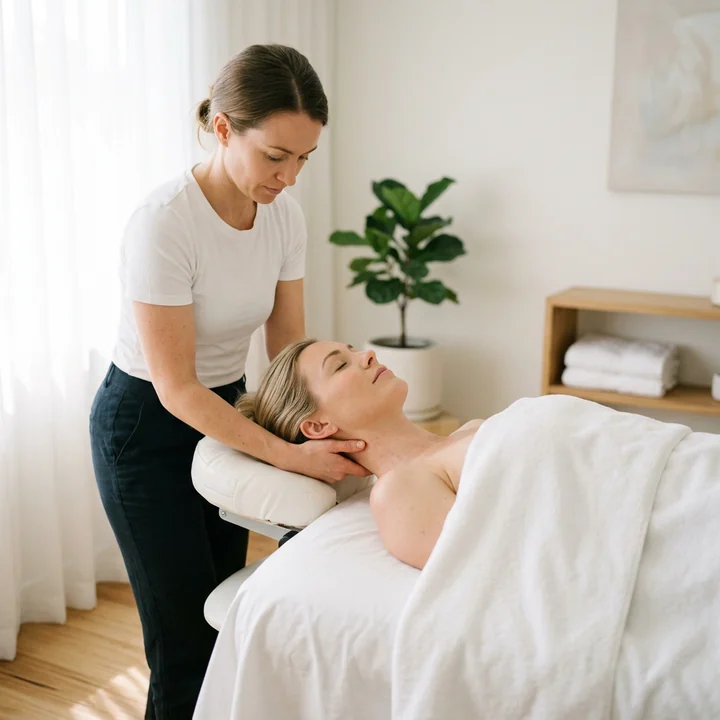
Expect to spend part of the session face up rather than face down, because the front and sides of the neck, the jaw and the scalp are hard to reach otherwise. Expect slow, sustained pressure at the base of the skull, and expect some of those points to be tender in a way that feels oddly familiar — that referred sensation running up into the head is often the moment people recognize where their headache has been coming from. Tell the therapist when it happens.
Two practical notes. Firm is not the goal; a neck that is already irritated does not want to be attacked, and the pressure that works is the deepest one you can stay relaxed underneath. And if headaches tend to arrive late in the working day, book late — we are open until 8 PM seven days a week, which is the reasoning behind our evening appointments page, and an appointment at 6:30 catches the problem on the day it happened instead of three days later.
- Mention the jaw, the temples and the scalp if you want them included. None of the three are automatic.
- Skip strong scented oil if smells are part of your headache picture. Unscented is always available for the asking.
- Heat helps some people and does nothing for others — hot stone work is worth trying once if tight shoulders are part of the pattern.
- Drink water afterward and give yourself twenty quiet minutes before driving back into traffic if you can.
- If a session reliably makes your head worse rather than better, tell your doctor — that is useful information about the headache, and worth pausing the neck work until you have an answer.
A headache session, start to finish
- Book the neck and shoulders, not a general full-body hour.
- Choose the half hour for the neck, the base of the skull and the scalp, or the full hour when the shoulders are as involved as the head.
- Say the word "headaches" at the start, and name the jaw, the temples and the scalp if you want them included.
- Expect to turn face up partway through, because the front of the neck, the jaw and the scalp are hard to reach otherwise.
- Tell the therapist when a tender point at the base of the skull sends a familiar sensation up into your head.
- Ask for less pressure the moment you cannot stay relaxed underneath it.
The head is where you notice a tension headache. It is very rarely where the problem is being made.
Questions readers actually ask
Can a massage get rid of a tension headache?
How do I know if it is a tension headache or a migraine?
Should I get a massage while a headache is happening, or wait?
What should I book for tension headaches?
Can a massage cause a headache?
How often would I need to come for it to help?
Do therapists work on the head and scalp, or only the neck?
Do I need an appointment for a headache session?
Sources
What the evidence says about massage for pain:
- NCCIH — Chronic Pain and Complementary Health Approaches
- NCCIH — 9 Things To Know About Chronic Low-Back Pain
- NCCIH — Massage Therapy for Health: What the Science Says
- NINDS — Headache
Massage in Oregon is state-regulated, and every practicing therapist must be licensed: the Oregon State Board of Massage Therapists requires 625 hours of training, a board-approved national exam plus an Oregon law exam, current Basic Life Support certification, and 25 hours of continuing education every two-year renewal — and it requires the studio itself to hold a Board-issued facility permit. Any licensed Oregon therapist or permitted studio can be verified for free on the Board's public lookup.
This is general wellness education, not medical advice. West Valley Massage is a relaxation and wellness studio, not a medical provider. Massage supports relaxation and general well-being; it does not diagnose or treat medical conditions. Talk with your doctor about pain that is new, severe, or not improving.
Reading about it is one thing. Feeling it is the other.
West Valley Massage · 1911 Mountain View Ln #300, Forest Grove, OR 97116 · Open daily, 9:00 AM – 8:00 PM · sessions from $40