
Guides · Massage & Pain
Massage for Back Pain
By the West Valley Massage team · 2,591 words · Sources: NCCIH, NINDS · Updated
7 red flags in section 03 · 3 independent sources · open daily 9 AM to 8 PM · Forest Grove, Oregon
Private rooms Open every day, 9 AM – 8 PM Walk-ins welcome
Forest Grove, OR 97116
What it does
What massage for back pain can do — and how to plan it
NCCIH's summary for people living with chronic low-back pain places massage among the approaches that may help with pain and function. That is a national health institute putting soft-tissue work on the list for the single most common reason people book an hour here, and it is worth knowing before you spend one.
The finding comes with a practical detail that changes how you book. The relief in the research shows up in the weeks following a course of sessions rather than after one appointment in isolation, so a run of sessions close together does more for a bad back than the same number spread across a year. NCCIH's review of complementary approaches for chronic pain covers the same ground.
The mechanism is straightforward. A back that hurts tends to guard: the muscles either side of the spine hold tension to protect a region that has been overloaded, and after a while that guarding becomes its own source of ache. Sustained, unhurried pressure gives the pattern a reason to let go, and what people report afterward is less pain and easier movement.
One boundary is worth naming, because it decides whether this is the right hour for you. Massage is soft-tissue work — it does not move a vertebra or change a disc, and Oregon licenses therapists for the muscles rather than the structure underneath. If your back pain comes with numbness, weakness, or pain running down a leg, see a physician first. Then book: the two work well together, and plenty of people here are doing both.
| What people book it for | What to expect |
|---|---|
| Relief from chronic low-back pain | NCCIH lists massage among the approaches that may improve pain and function. |
| Easier movement after a stiff week | Most people leave moving more freely than they arrived. |
| Sleeping better after a painful day | Commonly reported, and low-risk to try. |
| Sciatica or a disc problem | See a physician. Soft-tissue work does not change a disc or a nerve root. |
| Instead of exercise or physical therapy | Alongside them. Massage works with movement, not in place of it. |
| Massage flushes toxins out of sore muscles | There is no good evidence for this, and it is not why a back feels better. |
Telling them apart
Tight muscle, or something that needs a doctor
Most of the back pain that walks into a massage studio is muscular, and muscular pain has a recognizable shape. It is a spread-out ache, not one sharp point. It is worse after a long drive, a long shift, or a night on a bad mattress. It eases once you have moved around and tightens up again after you have been sitting a while. Press on it and you find a tender band that reproduces the feeling you came in with. Nothing about it travels anywhere else, and nothing about it involves your legs.
Pain that behaves differently deserves a different first appointment. Pain that shoots below the knee, pins and needles in a foot, a leg that feels unreliable on stairs, or an ache that is exactly the same standing, sitting and lying down — none of that reads as ordinary muscle tension, and none of it is a question a massage therapist is trained or licensed to answer. A physician, a physical therapist or a nurse line will sort it out faster than three hopeful sessions on a table will.
We would rather lose a booking than take one in the wrong situation. Oregon licenses massage therapists to do soft-tissue work, not to diagnose, and several of the questions we are asked most often genuinely belong to a clinic instead. If you are unsure which side of that line you are on, get the medical opinion first. The session you were going to book will still be there afterward, and it will be a better session for having an answer behind it.
- A dull ache spread across the low back, with no single sore point.
- Worse after sitting, driving or standing still; better once you have moved around for a few minutes.
- Tender to press, and pressing on it reproduces the exact ache you came in with.
- Heat helps for an hour or two. So does changing position.
- Nothing radiates into a leg, and nothing feels numb, weak or tingling anywhere.
Read this part
When to see a clinician instead of booking a massage
This section argues against our own booking calendar. A massage table is a poor place to find out that back pain was never a muscle problem in the first place. The signs below are the standard reasons a clinician pulls back pain out of the ordinary pile and looks harder at it, and any one of them means a medical opinion comes before a massage, not after it. None of them are common. All of them are worth knowing by heart.
None of this is a diagnosis, the list is not exhaustive, and what it amounts to is a triage habit. Certain combinations of symptoms have causes that matter enough to rule out first, including fracture, infection, nerve compression and, rarely, something systemic. The point is not to alarm anyone with an ordinary sore back after a weekend of yard work. The point is that ordinary sore backs do not usually arrive with a fever, unexplained weight loss, or numbness running down a leg — and when they do, the sensible next call is a clinic, not a studio.
If any of this describes you, call your doctor, a nurse line, or urgent care. Loss of bladder or bowel control, or numbness through the saddle area, is treated in every triage guideline as an emergency and should be seen the same day. And if you have already booked with us and something on this list turns up in the meantime, call and cancel. Nobody here will be annoyed. We would far rather you came back in three weeks with an answer than spent an hour face down with a question.
- Even when none of the above applies, tell the therapist about blood thinners, a recent surgery, an osteoporosis diagnosis, or a flare that started in the last day or two.
- If you are pregnant, say so when you book — that is a prenatal session with side-lying positioning, not an ordinary table setup.
- Bring the name of anything a doctor has already told you about your back. It changes how the hour is planned.
- If a session ever makes the pain sharply worse rather than gradually easier, say so in the room, while the therapist can still change what they are doing.
| Warning sign | Why it changes the answer | What to do |
|---|---|---|
| Pain that started with a fall, a crash, or a heavy impact | A bone injury has to be ruled out before anything presses on it | Urgent care or your doctor first |
| Numbness, pins and needles, or weakness anywhere in a leg or foot | That pattern points at a nerve, not a muscle | See a clinician before booking |
| Any loss of bladder or bowel control, or numbness around the groin | Treated as an emergency in every triage guideline there is | Emergency care the same day |
| A fever alongside the back pain | Infection sits on the list of causes, and massage does nothing for it | Call a doctor |
| Unexplained weight loss with new back pain | That combination needs a medical explanation before a wellness one | See your doctor |
| Pain that wakes you at night, or is no better lying down | Muscular pain usually eases once the load comes off it | See your doctor |
| Pain that is new, severe, and clearly worse week over week | An escalating pattern deserves a diagnosis, not a treatment guess | See your doctor |
In the room
What a session for a bad back looks like
It starts with a short conversation, and that conversation is worth more than the first ten minutes of the massage. The therapist will ask where it hurts, how long it has been going on, what makes it worse, and whether anything travels. Answer specifically. "Low back, left side, since I moved a couch three weeks ago, worse after driving" tells a therapist how to spend the hour. "My back is tight" does not, and the hour gets spent finding out what you could have said at the door.
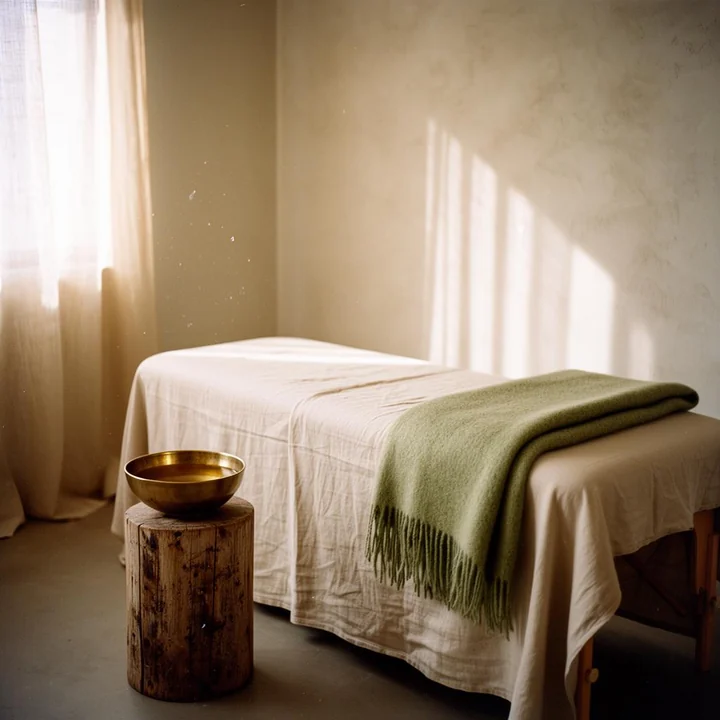
Then you get the room to yourself to undress to whatever level you are comfortable with, and you stay draped the entire time — only the area being worked is uncovered. For back work you will usually start face down with a bolster under your ankles, which takes the arch out of your low back and is the single thing that makes the position tolerable for people whose backs hurt. If face down is not comfortable, say so. Side-lying with a pillow between the knees is a normal alternative, not a special request.
The work itself tends to go somewhere people do not expect. Therapists spend a lot of a back session on the glutes, the hips and the band of muscle running from the ribs to the pelvis, because a low back that aches is frequently the region complaining about what the hip is doing. Pressure builds gradually. Expect slow strokes and pauses held in one place rather than fast, dramatic work, and expect to be asked more than once whether the pressure is right.
From the door to the table
- Say where it hurts, how long it has been going on, and whether anything travels.
- Mention blood thinners, a recent surgery, an osteoporosis diagnosis, or a flare that started in the last day or two.
- Take the room to yourself, undress to whatever level you are comfortable with, and settle under the drape.
- Start face down with a bolster under your ankles, or ask for side-lying with a pillow between the knees.
- Answer honestly when the therapist checks the pressure — adjusting it three times in an hour is normal.
Saying where it hurts, and how
Point at it. Genuinely — reach around and put a finger on the spot before you get on the table, because "lower back" covers a region the size of a dinner plate and the useful area is usually smaller than a palm. If it moves around, say that too; pain that wanders is a different problem from pain that lives in one place, and it changes what the therapist tries.
Describe the feeling in ordinary words. Aching, gripping, burning, stiff, catching when you turn. There is no technical vocabulary you are supposed to know, and using one you half-remember from the internet is usually less helpful than saying it plainly. The therapist is matching your description to what the hands find, and plain words match better.
Pressure, and the idea that harder is better
Firm is not the same as painful, and a back that is already guarding does not respond well to being attacked. If you are bracing, holding your breath, or gripping the table, the pressure has gone past useful and the muscle is now tightening against it — which is the opposite of the point. Ask for less. Nobody will take it as a verdict on the massage.
The pressure that works is usually the deepest one you can stay relaxed underneath. That level is different from person to person and different on different days, and it is also different from one part of your back to another. Adjusting it three times in an hour is normal. Deciding at minute five and suffering through the rest is the mistake, and the deep tissue versus Swedish question is really this question wearing a different name.
The day after
Mild soreness for a day or two after firm back work is common, and it usually feels closer to the ache after unfamiliar exercise than to the pain you came in with. Drinking water and moving normally is the standard advice, and a warm shower is more useful than lying still. Most people find the loosest they feel is not that evening but the following morning.
What is not normal: sharp new pain, anything numb or tingling, or pain that is clearly worse forty-eight hours later. That is worth a call to your doctor rather than a second appointment, and worth telling us as well so the next session is planned differently. Honest feedback about a session that did not work is more valuable to a therapist than a polite thank-you on the way out.
What to book
Why one region often beats a full-body hour
Think about how a full-body hour divides itself. Back, shoulders, arms, legs, feet and neck all get a share, which means the low back gets a fraction of the session no matter how enthusiastically you mention it at the start. That is fine when your whole body is tired. It is a poor use of the hour when one region is clearly the problem and everything else feels reasonably fine.
That is what the Local Massage on our menu is for. The entire session goes into one region — the low back and hip, the neck and shoulders, one leg — layer by layer, slowly, with the therapist checking in about what you feel. It is the most technical work on the menu and the most expensive per minute, and for a specific back complaint it is usually the better booking even though it is the shorter one.
Full-body still wins in three situations: this is your first massage and you do not yet know what you like, your back aches but so does everything else, or you are there for the hour of quiet as much as the sore spot. And if what you want is firmer pressure and not a narrower focus, you are choosing a technique, not a service — the same question we cover on the deep tissue page for people driving in from the Hillsboro side of the valley.
| Session | Length | Price | When it is the right pick |
|---|---|---|---|
| Local Massage | 30 min | $50 | One region is clearly the problem and you have a lunch break rather than an afternoon. |
| Local Massage | 60 min | $100 | The low back and hip have been bad for weeks and you want the whole hour spent there. |
| Body Massage | 60 min | $80 | Your back aches but so does everything else, or this is your first massage. |
| Body Massage | 90 min | $120 | You want a full-body pass and real time on the back inside the same session. |
The rest of the week
What matters more than the massage
A session works best as part of how you treat the week. Current guidance for ordinary low-back pain leans toward staying gently active rather than resting it — walking, changing position often, not spending three days on the sofa waiting for it to pass. A massage makes that easier to do, which is most of what people are booking it for: getting moving again without fighting your own back the whole way.
Cleveland Clinic's overview of massage therapy frames it the way we would: massage sits alongside conventional care. The people who get the most out of regular sessions are almost always the ones who are also doing something else — a strength routine, a physical therapy plan, a better chair, a mattress that is not eleven years old. Massage makes all of it more comfortable to keep up.
On frequency, the practical rule is to notice how long the relief lasts and book to that interval. Our guide on how often to get a massage works through the arithmetic. And one thing worth saying: if three sessions have made no difference at all to a back that has hurt for months, get a diagnosis alongside — there may be something underneath that soft-tissue work was never going to reach.
A massage is a reasonable thing to try for a stiff, aching back. It is not a reasonable thing to try for a leg that has gone numb.
Questions readers actually ask
Does massage help back pain, or is that just marketing?
How many massages will it take before my back feels better?
Should I book deep tissue for a bad back?
Can I get a massage if I have a herniated disc?
Is it normal to be sore the day after a back massage?
Can I book a massage for back pain while pregnant?
Do I need an appointment, or can I walk in with a sore back?
What if I am not sure whether to see a doctor first?
Sources
What the evidence says about massage for pain:
- NCCIH — Chronic Pain and Complementary Health Approaches
- NCCIH — 9 Things To Know About Chronic Low-Back Pain
- NCCIH — Massage Therapy for Health: What the Science Says
- NINDS — Headache
Massage in Oregon is state-regulated, and every practicing therapist must be licensed: the Oregon State Board of Massage Therapists requires 625 hours of training, a board-approved national exam plus an Oregon law exam, current Basic Life Support certification, and 25 hours of continuing education every two-year renewal — and it requires the studio itself to hold a Board-issued facility permit. Any licensed Oregon therapist or permitted studio can be verified for free on the Board's public lookup.
This is general wellness education, not medical advice. West Valley Massage is a relaxation and wellness studio, not a medical provider. Massage supports relaxation and general well-being; it does not diagnose or treat medical conditions. Talk with your doctor about pain that is new, severe, or not improving.
Reading about it is one thing. Feeling it is the other.
West Valley Massage · 1911 Mountain View Ln #300, Forest Grove, OR 97116 · Open daily, 9:00 AM – 8:00 PM · sessions from $40